
Why Handwriting Matters
The Science behind
Pencils vs. Keyboards
I was in a classroom watching a room full of second graders “journal.” Except nobody was journaling. Everybody was typing. Tiny fingers hunting and pecking across a keyboard, eyes squinting at the screen, trying to find the letter S like it was buried treasure. And I stood there thinking: when did we decide this was the same thing as writing?
If you have stepped into an elementary classroom lately, you have probably noticed the shift too. Spelling tests are typed. Journal entries happen on Chromebooks. Kids are learning to navigate a keyboard before they have even figured out how to hold a pencil without it looking like they are stabbing the paper.
I get it. Typing is fast. It is tidy. It is a skill our kids will absolutely need for the rest of their lives. But here is the question that keeps rattling around in my brain, both as an educator and as someone who talks to parents constantly: are we quietly trading away something important for the sake of convenience?
Your Brain Does NOT Treat Handwriting and Typing the Same
For a long time, the assumption floating around education was that writing is writing. Press a key, drag a pencil, same cognitive work happening behind the scenes, right?
Wrong. So wrong. And neuroscience has receipts.
Researchers at the Norwegian University of Science and Technology used EEG technology to map brain activity while people wrote by hand versus typed. The findings were dramatic. Handwriting lit up widespread brain connectivity that typing simply did not activate. The precise, coordinated hand movements involved in forming letters with a pen appear to build connectivity patterns that support real learning. And here is the kicker: the researchers specifically flagged this as most important for young children, whose brains are still very much under construction.
This was not a fluke study either. A 2025 systematic review combed through 30 separate neuroimaging studies and landed on the same conclusion. Handwriting and typing are fundamentally different tasks for the brain. They differ in motor demands, timing, sensory processing, and developmental outcomes.
Translation? Your kid’s brain knows the difference, even if we adults act like it does not matter.
Letter Formation Is Doing WAY More Work Than You Think
Here is the part that genuinely stopped me in my tracks. Handwriting is not just a fine motor skill hanging out next to reading, minding its own business. It is actually part of how children learn to read in the first place.
When kids physically trace the shape of a letter with their own hand, as opposed to typing it or tracing over pre-made dots, it activates the exact brain regions responsible for letter recognition down the road. NPR covered this extensively, and the takeaway was clear: kids who hand-copy letters develop stronger, longer-lasting letter recognition than kids who type them.
A 2025 study out of the University of the Basque Country tested this directly with children who were learning to read for the very first time. The kids who traced letters by hand showed stronger recognition of those letters later on. Meanwhile, the kids in the typing group showed weaker gains overall.
Let that sink in for a second. This is not just “handwriting helps kids learn letters a little faster.” This is “handwriting helps the learning actually stick,” while typing lets it slip right through the cracks.
Researchers point to something called grapho-motor action as the mechanism here, which is a fancy way of describing the physical, tactile experience of forming letters by hand. That same 2025 study found that this tactile, motor-driven experience plays a critical role in embedding alphabetic knowledge into the brain’s learning systems. And the researchers went as far as cautioning that swapping handwriting for typing during those early years might actually get in the way of reading development, rather than being some kind of neutral, no-harm substitution. Yikes!
This Is Not Just a Kindergarten Problem
Now, you might be thinking, okay, this all makes sense for five- and six-year-olds learning their ABCs, but surely once kids know how to read, keyboards are totally fine, right? Not so fast.
One of the most frequently cited studies on this entire topic was not even about young kids. It was about college students taking lecture notes. Researchers Mueller and Oppenheimer had students take notes either by hand or on a laptop, then tested their retention later. The students who typed their notes on laptops performed WORSE on conceptual questions than the students who wrote their notes by hand.
And it was not simply about distraction, though let us be honest, laptops are basically distraction machines. The real issue was how students processed information. Laptop note-takers tended to transcribe lectures nearly word for word, capturing everything but understanding very little. Handwriting, being slower and more effortful, forced a completely different kind of cognitive engagement. Students had to summarize, prioritize, and translate ideas into their own words in real time.
The slowness of handwriting is not a bug. It is the entire feature. That friction is exactly what forces deeper thinking to happen.
So What Do We Actually DO With This Information?
To be crystal clear, I am not standing on a table declaring keyboards evil and typing forbidden. Digital literacy absolutely matters, and there are plenty of moments where typing is the right tool. Drafting a long piece of writing, using assistive technology, preparing kids for very real future tasks… typing has its place.
Even the researchers behind these studies frame this as both, not either or. As Edutopia summarized it, typing might be faster, but handwriting engages the brain in richer, more meaningful ways, particularly during those early years when foundational skills are still being built.
Here is what I want both teachers and parents walking away with:
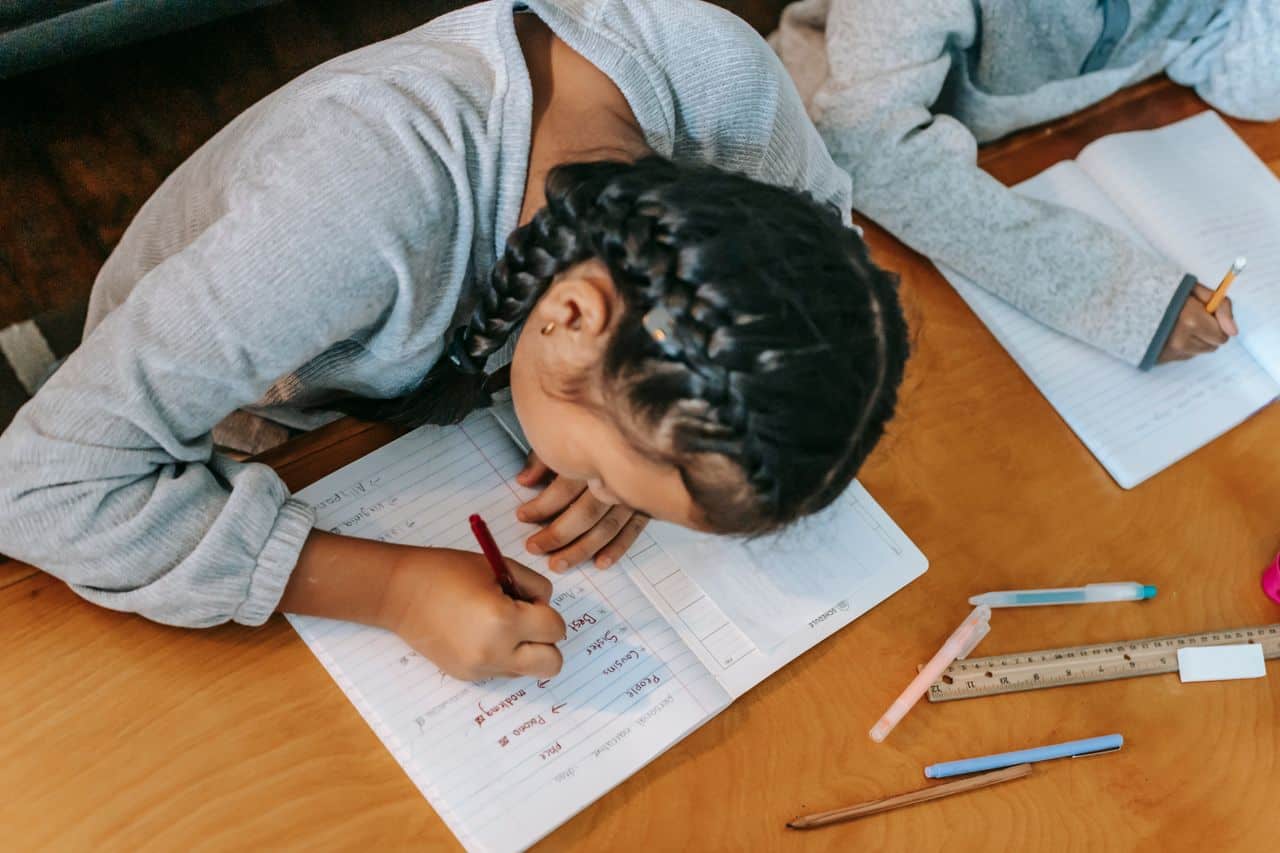
Protect daily handwriting time, especially in the early grades. Even ten to fifteen minutes of purposeful handwriting practice supports the neural pathways kids need for reading, not just for pretty penmanship.
Let young kids trace and copy letters by hand before they start typing them. If a child is still learning to read, this is not some nice little extra. This is foundational, brain-building work.
Use handwriting for thinking, and typing for producing. Journaling, brainstorming, and note-taking should happen by hand. Save typing for final drafts and longer projects. This mirrors exactly what the research on college students revealed.
Do not feel behind if your child’s school still emphasizes handwriting. It is not old-fashioned. It is not stuck in the past. It is backed by a growing, seriously robust body of neuroscience.
The Bottom Line
This is not about resisting technology or pretending we live in 1995. This is about recognizing that for young, developing brains, the HOW of writing is doing far more work than we typically give it credit for.
A pencil in a small hand is not just teaching a child to write. It is helping build the very architecture that child will use to read, think, and learn for years to come.
So the next time you watch a kid slowly, painstakingly trace out a wobbly letter B, do not rush them along. That wobble is doing something powerful.
What’s your take? Does your family still prioritize handwriting practice at home? Drop a comment below, I would love to hear how you are navigating this in your own house!